
“Find a job you love because you’re
going to be doing it an awful lot!”
–
Mary Ruth Straw is 60 years old and has been a teacher, a special educational needs co-ordinator (SENCo) and Head of Year based in Tower Hamlets. Mary has made the transition from secondary to primary school teaching. Despite describing herself as “not particularly career minded”, Mary has taught in an impressive range of places, catering for different needs and ages. Her experiences include working as a Maths teacher in a high school for teenagers aged 14-18 years in America, also working in a leprosy village in India when she was 23 years old, teaching kindergarten children how to read and write. Mary has also taught in church schools, and her Christian faith is important to her. Mary is married to Steve, and she has two grown up children, and a dog.
Read on to learn more about Mary!
Starting out I went to University and obtained a degree in Maths. I graduated in 1986. In my final year I had lots of job interviews at various corporate places but they weren’t the right fit for me and I didn’t get beyond the first interview stage. At that time everyone who graduated in Maths got offered a bursary of £600 to train as a Maths teacher, which was a lot of money in 1986. So I went to Goldsmiths University in London and did a Maths PGCE and loved it. It worked to my strengths. And I’ve been a teacher ever since.
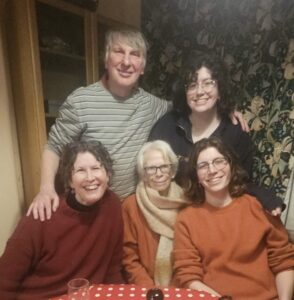
Mary (bottom left) with her family
I love being a Maths teacher but once you’ve taught Pythagoras Theorem 15 times you can get a bit weary of it! What I found I was really interested in, was the pastoral side of the work. So I became Head of Year at George Green’s school on the Isle of Dogs in London. And I loved it. I took my year group from year 7 to year 11. What I really liked was working with the children with more complicated needs who needed a lot more help. When my year group got to year 11 I wasn’t sure I could do it all again because it’s quite an emotional journey. So I thought perhaps I would like to work just with the more complicated children.
I then worked at George Green’s school for 4 years, running a unit of 20 children who were in 6th Form but were not studying A Levels. They had learning difficulties. Some had Downs syndrome. Some had global delay. Some had physical disabilities as well. I left there and went to work as a SENCo at a school called Greycoats in West London for 3 years. The children there presented with a variety of needs such as Autism, Dyslexia, and Cerebral Palsy. After that I became Head of Inclusion at Stoke Newington school for about 12 years. I had a team of 30 people including learning support assistants (LSA’s), school counsellors, and literacy tutors.
“In terms of my values, I think all people should
be taken seriously. Inclusion is important.
Sometimes kids just need a tiny bit of adaptation
and they can thrive. One size does not fit all.”
To become a SENCo you have to do this qualification which is like half a Masters degree so I’ve done that along my career journey. I’m very much a secondary school teacher. I had never thought about going into primary education. But I left Stoke Newington school in 2020 and some time later a parent of a child at Stoke Newington emailed me and said they really need a SENCo for 3 days per week in a primary school and was I interested? And I just said yes, why not? So for the last 3 years I have been SENCo at Mandeville primary school in Hackney.
Working in a primary compared to a secondary school, it’s a very different kind of job. You could assume that children with special needs are all the same, whether they’re 5 or 15 years old, but actually schools are very different. Primary schools are all about learning to read and write. It’s nice being in a primary school. I get to cycle to work. And I just work 3 days a week. I’m now 60 and thinking about whether I’m going to stop in the next few years and if so, what am I going to do in the next chapter of my life?
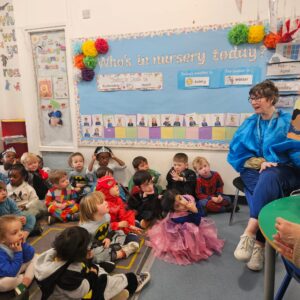
Mary dressed as the genie from Aladdin on World Book Day
A typical day in my life at present begins when I get up at 6:30am. I make sure my mum’s OK. She’s living with us at the moment because she’s a bit frail. My mother has a carer. So I put the dog somewhere separate from the carer, and wait while the carer arrives and washes and dresses my mum. I leave for work at 8am after having breakfast. My husband makes me a packed lunch. I cycle through the park and get to the school at 8:30am. Then from 8:30am till 5pm I’m at work. I sit in the canteen with the children at lunchtime. We have a chef on site who makes a healthy lunch for all the children which is free. The idea is that you have an adult sitting on each lunch table. And so I sit down with some children and just talk to them. It’s really about building relationships.
After work we have a senior leadership team (SLT) meeting on a Monday where I go and give feedback on what I’ve been doing. They have Phase meetings on a Wednesday. There are 3 Phases ranging from nursery and reception, up to year 6. Each Phase has a person in charge. So I might go along to one of those meetings because it’s a good way to find out which kids are struggling. Otherwise I’ll just be meeting parents or doing admin. I leave work by 5pm and cycle home. I see my husband, my mother, and my dog. I sit in the garden. On Monday and Wednesday evenings I go to Pilates. I don’t work Thursday or Friday. On Friday I play my clarinet with an adult learners orchestra. On Sundays I go to church and run the Sunday school.

Mary (right) and her children on a PRIDE march
I’ve done many jobs over the years, but I liked being a Head of Year. I like children. I don’t think anyone goes into teaching for the money or the prestige. I went into teaching because it’s the kind of job where I can be me. I think that state education is really important. Is it a vocation? I don’t know. Maybe. It’s a difficult job and the reason I’m still there is I’m not in the classroom teaching. I’m not on the front lines, which is completely exhausting. I’d like to see people-centred jobs and soft skills valued more. Personally I think teachers should get an award!
To read more “day in the life” articles and much more, click here to view the blog of The Careers Company.